Where Is England Located and How Does It Fit Into the UK?
England is a country located in Northwest Europe, occupying the southern two-thirds of the island of Great Britain. It shares land borders with Scotland to the north and Wales to the west. While England is a distinct nation with its own history and culture, it is not a sovereign state; rather, it is the largest of the four constituent countries that form the United Kingdom (UK).
Understanding the location of England requires navigating a series of "nested" geographic and political identities. To many international observers, the terms "England," "Great Britain," and "the United Kingdom" are often used interchangeably, yet they refer to very different entities. England is the dominant landmass of the British Isles, housing more than 80% of the UK's total population and serving as the historical heart of the British government.
Geographically, England is defined by its maritime surroundings and its proximity to mainland Europe. It sits at a crossroads of the Atlantic world and the European continent, a position that has shaped its climate, its economy, and its role in global history. From the white cliffs of the south coast to the rugged hills of the north, England's location is central to its identity as an island nation—even if it technically shares that island with two other countries.
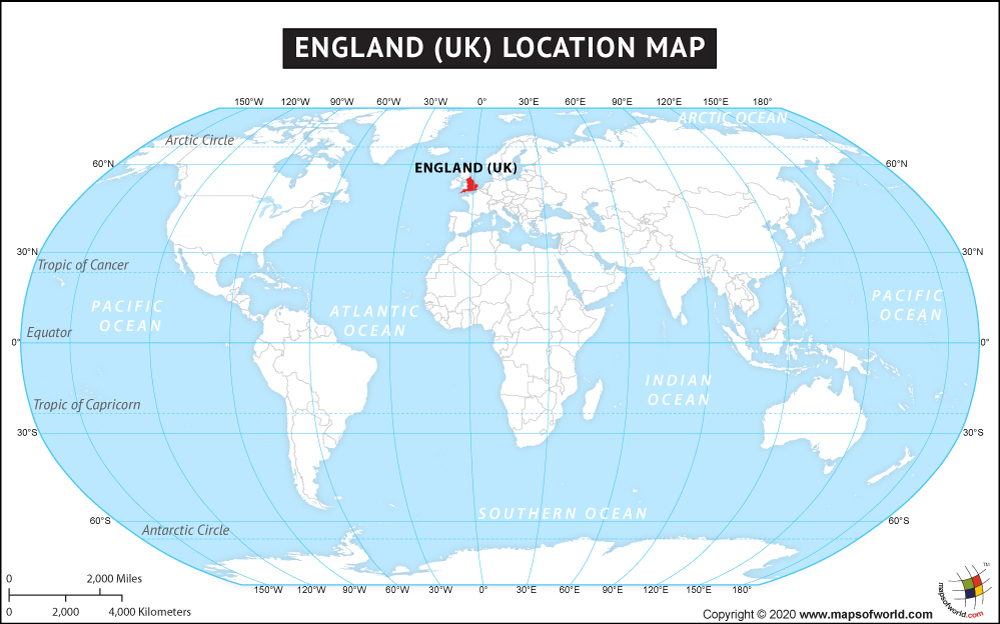
Image source: World Map
Where Is England on the World Map?
On a global scale, England is situated in the Northern Hemisphere. Its longitudinal position is particularly significant because the Prime Meridian (0° longitude) passes directly through Greenwich in London. This means England is one of the few places on Earth that technically sits in both the Eastern and Western Hemispheres, though the vast majority of its landmass lies to the west of the meridian.
Global Coordinates and the Prime Meridian
England's coordinates roughly span from 50° to 56° North latitude. This northern position typically suggests a cold climate, but thanks to the North Atlantic Drift (an extension of the Gulf Stream), England enjoys a much milder, temperate maritime climate than other regions at similar latitudes, such as parts of Canada or Russia. The Royal Observatory in Greenwich remains a global landmark, marking the point from which all world time zones are measured.
Maritime Boundaries and Surrounding Seas
England is almost entirely surrounded by water, which has historically provided a natural defense and a gateway for global trade. Its maritime boundaries include:
- The North Sea: Located to the east, separating England from Scandinavia and the Low Countries.
- The English Channel: To the south, this narrow stretch of water separates England from northern France. At its narrowest point, the Strait of Dover, the distance is only about 21 miles (34 km).
- The Celtic Sea: Situated to the southwest, leading into the vast Atlantic Ocean.
- The Irish Sea: To the northwest, separating England from the island of Ireland.
According to Britannica, no point in England is more than 75 miles (120 km) from the sea. This proximity to the coast has deeply influenced English culture, from its naval history to its modern tourism industry.
Is England a Country or a State?
One of the most frequent points of confusion for travelers and students alike is whether England is a "country." The answer is yes, but with a significant caveat: it is a constituent country. It is a nation with its own flag (the Cross of St George), its own national anthem (often "Jerusalem" or "God Save the King"), and a distinct cultural heritage, but it lacks independent sovereignty.
The "Country within a Country" Status
England is one of the four nations that make up the United Kingdom of Great Britain and Northern Ireland. The other three are Scotland, Wales, and Northern Ireland. While England is the largest and most populous member, it does not issue its own passports. If you are from England, your passport is a British one, and your sovereign head of state is the British Monarch. In international diplomacy and at the United Nations, it is the United Kingdom that is recognized as the sovereign state, not England individually.
Governance and the Lack of a Devolved Parliament
Interestingly, England is the only nation in the UK that does not have its own devolved government. While Scotland has the Scottish Parliament, Wales has the Senedd, and Northern Ireland has the Assembly, England is governed directly by the UK Parliament at Westminster. This has led to the "West Lothian Question"—a political debate regarding whether Scottish, Welsh, and Northern Irish MPs should be allowed to vote on laws that only affect England, while English MPs have no say in the devolved matters of the other nations.
| Term | Definition | Includes | Sovereign? |
|---|---|---|---|
| England | A constituent country | England only | No |
| Great Britain | A geographic island | England, Scotland, Wales | No |
| United Kingdom | A sovereign state | England, Scotland, Wales, NI | Yes |
| British Isles | An archipelago | UK, Ireland, and islands | N/A |
How England Was Formed and Separated from Europe
England was not always an island. For much of its geological history, it was a peninsula of mainland Europe. The process that led to its current location and isolation is a fascinating tale of rising sea levels and cataclysmic events that occurred thousands of years ago.
The Lost World of Doggerland
Until approximately 8,000 years ago, a vast land bridge known as Doggerland connected the eastern coast of England to what is now Denmark, Germany, and the Netherlands. This was a fertile, inhabited landscape where Mesolithic hunter-gatherers lived among mammoths and deer. As the last Ice Age ended and glaciers melted, sea levels began to rise, slowly turning Doggerland into a series of islands before it eventually vanished beneath the North Sea.
The Storegga Tsunami and the Birth of the Channel
The final separation of England from the continent was likely accelerated by a dramatic event known as the Storegga Slide. Around 6,100 BCE, a massive underwater landslide off the coast of Norway triggered a colossal tsunami. This wall of water swept across the North Sea, flooding the remaining lowlands of Doggerland and permanently carving out the English Channel. This event transformed England into an island nation, a geographic shift that has dictated its political and cultural trajectory ever since. According to research cited by Wikipedia, this isolation allowed England to develop a highly distinctive legal and social framework compared to its continental neighbors.
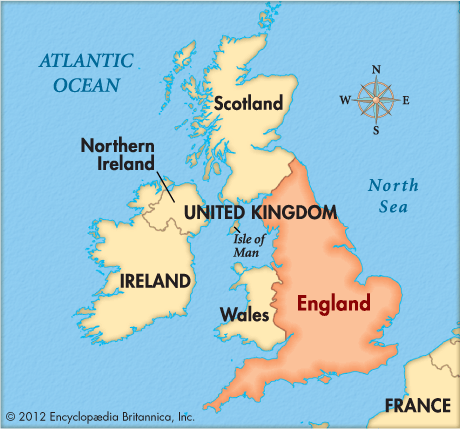
Image source: Britannica Kids
Who Are England's Closest Neighbors?
Despite being on an island, England is far from isolated. Its borders—both land and sea—connect it to a variety of neighbors, each with a complex historical relationship with the English people.
Land Borders with Scotland and Wales
England shares two land borders. To the north lies Scotland, separated by a 96-mile (154 km) border that runs from the Solway Firth in the west to the River Tweed in the east. This border has shifted many times over centuries of conflict before the 1707 Acts of Union joined the two kingdoms. To the west lies Wales, with a 160-mile (257 km) border. The Welsh border is largely defined by the ancient earthwork known as Offa's Dyke, though the modern administrative border follows a slightly different path.
Proximity to Continental Europe
To the south, England's closest neighbor is France. The proximity is so close that on a clear day, the French coast is visible from the White Cliffs of Dover. This 21-mile gap is now bridged by the Channel Tunnel, allowing trains to travel from London to Paris in just over two hours. Other nearby maritime neighbors include Belgium and the Netherlands to the east, and the Republic of Ireland to the west across the Irish Sea.
Why Does England Have Its Own National Sports Teams?
If England is not a sovereign state, why does it have its own team in the FIFA World Cup? This is a common question that highlights one of the few areas where England operates as a completely separate entity from the rest of the UK.
Historical Legacy of Sporting Associations
The reason is primarily historical. England was the birthplace of many modern sports, including football, rugby, and cricket. Because the English Football Association (FA) was founded in 1863—long before international governing bodies like FIFA existed—it was already an established national entity. When international competitions were formed, the four UK nations (England, Scotland, Wales, and Northern Ireland) were granted individual membership as a nod to their role in pioneering the games.
Cultural Identity through International Competition
For many people in England, sports are the primary venue where they express an "English" identity as opposed to a "British" one. While athletes compete under the "Team GB" banner during the Olympics, the separate national teams in the World Cup or the Six Nations Rugby tournament allow for a distinct celebration of English heritage. This "sporting exception" is widely regarded as one of the most visible ways England maintains its national character within the larger framework of the United Kingdom.
"England is perhaps the only country in the world where the national identity is most fiercely defended on the football pitch rather than in the halls of parliament."
Understanding the "England and Wales" Legal System
Another unique aspect of England's "where" and "what" is its legal jurisdiction. While Scotland and Northern Ireland have their own entirely separate legal systems, England and Wales are bound together in a single jurisdiction known as English Law.
A Shared Jurisdiction under English Law
This arrangement dates back to the 16th century, when the Laws in Wales Acts formally incorporated Wales into the English legal framework. Today, while Wales has its own devolved legislature that can pass specific laws, the core court system and the principles of Common Law remain shared. This is why you will often see legal documents or government reports addressed to "England and Wales" as a single unit. English Law is highly influential globally, serving as the basis for the legal systems in the United States, Australia, Canada, and many other Commonwealth nations.
Major Cities and Regional Hubs in England
England is divided into nine official regions, but most people think of it in terms of its major cities and the "North-South Divide."
London as the Global Anchor
Located in the southeast, London is the capital of both England and the United Kingdom. It is a massive global hub for finance, culture, and transit. Approximately 9 million people live in London, making it one of the most populous cities in Europe. Its location on the River Thames was originally chosen by the Romans (Londinium) because it was the furthest point inland that could be reached by sea-going vessels.
The North-South Divide and Regional Identity
Beyond London, England's geography is defined by its regional hubs. The "North" includes industrial powerhouses like Manchester, Liverpool, Leeds, and Newcastle. These cities were the heart of the Industrial Revolution and maintain a very strong, distinct cultural identity. The "Midlands" features Birmingham, the UK's second-largest city. The "Southwest" is known for its rural beauty and cities like Bristol. Understanding where England is also means understanding these internal boundaries, which often dictate everything from local accents to economic opportunities.
Key Takeaways Regarding England's Location and Status
- Geographic Position: England is located in Northwest Europe on the island of Great Britain, surrounded by the North Sea, English Channel, and Irish Sea.
- Political Status: It is a constituent country of the United Kingdom, not a sovereign state, and accounts for over 80% of the UK's population.
- Land Borders: England shares land borders with Scotland to the north and Wales to the west.
- Historical Formation: England was once connected to Europe via Doggerland until rising sea levels and a massive tsunami created the English Channel roughly 8,000 years ago.
- Administrative Quirk: Unlike its UK neighbors, England lacks its own devolved parliament and shares a legal jurisdiction with Wales.
- Global Significance: The Prime Meridian passes through London, placing England at the center of global timekeeping.
To truly understand where England is, one must look past the map and see it as a nation deeply integrated into a larger union while maintaining a highly distinctive cultural and historical footprint.
Frequently Asked Questions
Is England a city or a country?
England is a country, not a city. It is one of the four nations that make up the United Kingdom. London is the largest city in England and serves as its capital, as well as the capital of the UK. Confusing the two is a common mistake, but England covers over 50,000 square miles, whereas London is a metropolitan area within it.
Is England in the United States?
No, the country of England is located in Europe. However, there are several towns and cities in the United States named "England" (such as England, Arkansas) or named after English cities (like New York, Boston, and Birmingham). This is due to the colonial history of the U.S., but the original nation of England is thousands of miles away across the Atlantic Ocean.
What continent is England in?
England is located on the continent of Europe. Specifically, it sits on the European continental shelf in the northwest. While the UK has left the European Union (a political and economic organization), it remains geographically part of the European continent.
Does England have its own King?
England shares its monarch with the rest of the United Kingdom. There is no separate "King of England"; the official title is the King of the United Kingdom of Great Britain and Northern Ireland. The current monarch is King Charles III, who serves as the head of state for all four UK nations.
What is the difference between England and Great Britain?
Great Britain is a geographic term referring to the entire island that contains England, Scotland, and Wales. England is a political term referring to just one of the countries on that island. Therefore, all English people are British (because they live on Great Britain), but not all British people are English (some are Scottish or Welsh).
What currency is used in England?
The currency used in England is the Pound Sterling (£/GBP). While England is part of Europe, it never adopted the Euro. The Bank of England, located in London, is the central bank responsible for issuing banknotes and managing monetary policy for the entire United Kingdom.