What Is Light Roast Coffee and How Does It Actually Taste?
Light roast coffee refers to beans roasted to the "first crack" (typically 356°F–401°F). These beans are characterized by a matte, oil-free surface and a light brown color similar to cinnamon. Unlike darker roasts, light roasts preserve the terroir—the unique flavors of the bean's origin—resulting in a bright, acidic, and complex cup with floral or fruity notes.
In the modern specialty coffee landscape, light roast coffee has emerged as a top choice for enthusiasts who value transparency and complexity. While traditional commercial coffee often relies on heavy roasting to mask defects or create a uniform "charred" flavor, light roasting acts as a window into the bean's soul. It allows the specific environmental factors of the farm—the soil, altitude, and climate—to dictate the final flavor profile.
As of 2026, the trend toward "origin-forward" roasting has only intensified. Roasters are increasingly focusing on highlighting the delicate nuances of high-altitude Arabica beans, moving away from the smoky, bitter profiles of the past. Whether you are a seasoned barista or a curious newcomer, understanding the science and sensory experience of light roast coffee is essential for mastering the modern brew.
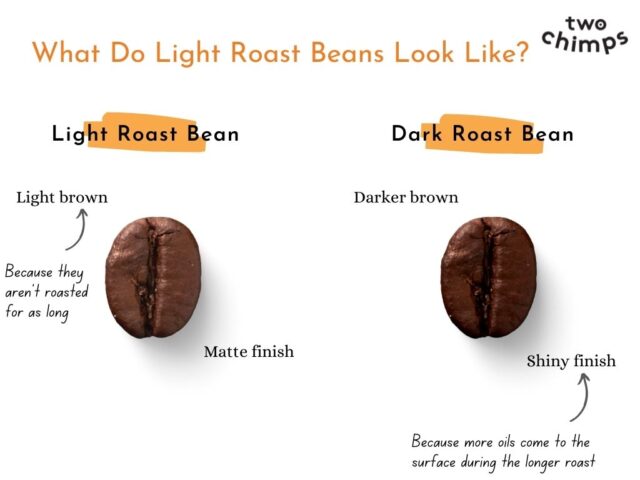
Image source: Two Chimps Coffee
How Is Light Roast Coffee Made?
The journey from green coffee to a light roast is a delicate balancing act of heat and time. Light roasts spend the least amount of time in the roaster, often finishing well under 20 minutes (Peet's Coffee). The goal is to apply enough heat to trigger essential chemical reactions without incinerating the delicate organic compounds that provide flavor.
During the roasting process, the beans undergo the Maillard reaction, where amino acids and reducing sugars react to create hundreds of different flavor compounds. In a light roast, this process is carefully managed to ensure that sugars are lightly caramelized but not fully carbonized. This preservation of the bean's cellular structure is why light roasts retain more of their original moisture and density compared to their darker counterparts.
The Significance of the First Crack
The defining moment of a light roast is the "first crack." As the internal temperature of the bean rises, the moisture inside turns to steam, creating pressure. Eventually, the bean's cellular structure can no longer hold the pressure, and it physically expands and "pops" like popcorn (Coffee Bean Corral). This usually occurs when the internal temperature reaches approximately 380°F.
For a light roast, the roaster will pull the beans shortly after this first crack begins or just as it finishes. If the roasting continues until a "second crack" occurs, the beans move into the medium-to-dark territory, where the internal oils are forced to the surface and the origin flavors begin to dissipate.
Temperature Ranges for Light Roasting
Precision is key when monitoring roast levels. Internal bean temperatures for light roasts typically range from 356°F to 401°F. However, it is important to note that roaster thermometers can provide different readings depending on whether they are measuring the environmental air temperature or the bean probe temperature. According to Coffee Bean Corral, the range is often cited between 350°F and 410°F, reflecting the spectrum of "Light City" to "Half-City" roasts.
What Does Light Roast Coffee Look and Feel Like?
Identifying a light roast is relatively simple once you know what to look for. The most immediate indicator is the color. Light roast beans are often described as having a "cinnamon" or "cane sugar" hue (Compass Coffee). They lack the deep chocolate or near-black appearance of Italian or French roasts.
The texture is equally telling. Light roast beans have a completely matte finish. Because they have not been subjected to the intense heat required to break down the bean's internal cell walls, the natural oils remain trapped inside the bean rather than seeping to the surface.
Understanding Bean Density and Hardness
One of the most overlooked aspects of light roast coffee is its physical density. Because these beans are roasted for a shorter duration and at lower temperatures, they retain more moisture and have not expanded as much as dark roasts. This makes them significantly harder and heavier (Copper Moon Coffee).
Shelf Life and Oxidation
The lack of surface oil on light roast beans actually works in their favor regarding shelf life. Surface oils on dark roasts are highly susceptible to oxidation, which leads to rancidity. Since light roast oils are protected within the bean's structure, they often stay fresh slightly longer in their whole-bean form, provided they are stored in an airtight, cool environment.
Why Does Light Roast Coffee Taste So Different?
If you are used to the "coffee-flavored coffee" found in diners—which is usually a dark roast—your first sip of a light roast might be a shock. Instead of smoke, ash, and bittersweet chocolate, you are likely to encounter a flavor profile that resembles tea or fruit juice. This is because light roasting preserves the volatile aromatic compounds that are easily destroyed by high heat.
The mouthfeel, or body, of a light roast is typically thin and clean. It lacks the heavy, syrupy viscosity of a dark roast. This "tea-like" quality is highly prized in specialty coffee because it allows for greater clarity of flavor, making it easier to distinguish individual tasting notes like jasmine, bergamot, or red currant.
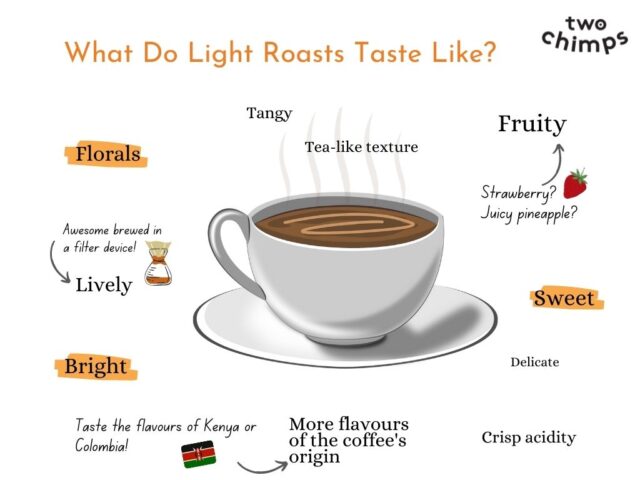
Image source: Two Chimps Coffee
The Role of Terroir and Origin Flavor
Terroir is a French term used in wine and coffee to describe how a particular region's environment shapes the product's flavor. Light roasting is the only way to truly experience terroir. For example:
- Ethiopian Yirgacheffe: Often yields notes of lemon, honeysuckle, and Earl Grey tea.
- Kenyan Coffee: Known for intense blackcurrant acidity and a wine-like finish.
- Central American Beans: Frequently display crisp apple acidity and nutty undertones.
How Processing Methods Change the Taste
The way the coffee cherry is removed from the bean also plays a massive role in light roast flavor. Washed process coffees are generally cleaner and more acidic. However, Natural process light roasts (where the fruit is dried on the bean) can taste like "liquid candy," offering jammy textures and intense berry flavors, such as the Ayarza Natural profile (Cody Coffee).
Does Light Roast Coffee Have More Caffeine?
There is a persistent myth that light roast coffee is significantly more caffeinated than dark roast because the caffeine "burns off" during longer roasts. In reality, caffeine is remarkably stable during the roasting process. The difference in caffeine content is not about the chemistry of the roast, but the density of the bean.
Because light roast beans are denser and smaller, the way you measure your coffee determines the caffeine intake:
- Measuring by Volume (Scoops)
- A scoop of light roast beans contains more individual beans than a scoop of dark roast. Therefore, a scoop of light roast will have more caffeine.
- Measuring by Weight (Grams)
- If you use a scale to measure 20 grams of coffee, the caffeine content will be roughly identical regardless of the roast level, as the caffeine-to-mass ratio remains stable (Coffee Bean Corral).
How to Tell the Difference Between Sour and Acidic Coffee
One of the biggest hurdles for people new to light roast is the "sourness" factor. It is common for beginners to mistake the high acidity of a light roast for a defect. However, there is a distinct difference between pleasant acidity and unpleasant sourness.
Acidity is a positive attribute in coffee. It provides a "sparkle" or "brightness" on the tongue, much like the crispness of a Granny Smith apple or the tartness of a dry white wine. It balances the sweetness and prevents the coffee from tasting flat.
Sourness, on the other hand, is usually a sign of under-extraction. Because light roast beans are so dense, they are harder for water to penetrate. If your water isn't hot enough or your grind is too coarse, the water will only pull out the acids and salts, leaving the sugars behind. This results in a sharp, puckering sourness that lacks sweetness.
- Grind Finer: Increasing the surface area allows the water to extract more flavor.
- Increase Temperature: Use water closer to boiling (205°F) to help break down the dense bean structure.
How to Brew the Perfect Cup of Light Roast Coffee
Brewing light roast requires a different approach than medium or dark roasts. Because light roasts are less soluble, you have to work harder to get the flavor out. A standard 1:16 or 1:17 brewing ratio (e.g., 20g of coffee to 340g of water) is a highly recommended starting point to allow the acidity to balance with the natural sweetness (Cody Coffee).
Why You Need Hotter Water for Light Roasts
While dark roasts are often brewed at lower temperatures (around 185°F–195°F) to avoid extracting bitter, carbonized flavors, light roasts thrive with heat. Using water at 200°F to 205°F—or even right off the boil—is essential for extracting the complex sugars that balance the high acidity. If the water is too cool, the coffee will inevitably taste thin and sour.
Tweaking Your Espresso for Light Roast Beans
Traditional espresso recipes (a 1:2 ratio, like 18g in and 36g out) often fail with light roasts, producing a "lemon juice" effect that is far too intense. Modern specialty baristas often use a 1:2.5 or 1:3 ratio for light roasts. By pulling a longer shot (e.g., 18g in, 45g–54g out), you increase the total extraction, which tames the acidity and brings out the floral and sweet notes that make light roast espresso so unique.
Light vs. Medium vs. Dark Roast Comparison
To help you decide which roast level fits your palate, here is a comparison of the primary characteristics across the roasting spectrum.
| Feature | Light Roast | Medium Roast | Dark Roast |
|---|---|---|---|
| Color | Light Brown (Cinnamon) | Medium Brown | Dark Brown / Black |
| Surface Oil | None (Matte) | Minimal to None | Oily / Shiny |
| Acidity | High / Bright | Balanced | Low / Muted |
| Body | Thin / Tea-like | Medium / Creamy | Heavy / Syrupy |
| Primary Flavor | Origin / Terroir | Balanced / Caramel | Roast / Smoke / Char |
What Is Nordic or Ultra-Light Roast Coffee?
In recent years, a trend known as "Nordic Style" roasting has gained traction in the specialty community. This involves roasting beans even lighter than the traditional specialty standard. The goal is maximum "transparency"—roasting just enough to make the coffee soluble while changing the green bean's chemistry as little as possible.
While Nordic roasts offer incredible aromatic complexity, they are also the most difficult to brew. They require precision equipment and very high-quality water to avoid tasting "underdeveloped," which can manifest as flavors of hay, grass, or raw grain. Despite the challenge, many enthusiasts consider this the top-tier expression of coffee's potential.
How Long Should You Let Light Roast Coffee Degas?
Freshness is usually a virtue in coffee, but light roasts require patience. When coffee is roasted, CO2 is trapped inside the beans. If you brew too soon, the escaping gas creates bubbles that prevent water from evenly contacting the coffee grounds, leading to uneven extraction.
Because light roasts are so dense, they release this gas much more slowly than dark roasts. While a dark roast might be at its peak 3 days after roasting, a light roast often needs 7 to 14 days of resting to reach its full flavor potential. During this window, the harsh acidity mellows, and the sweetness becomes more pronounced.
The Bottom Line on Light Roast Coffee
Light roast coffee is a celebration of the bean's origin, offering a complex and vibrant experience that differs significantly from traditional dark roasts. Here are the key takeaways:
- Visual Cues: Look for light brown, matte beans with no visible oil on the surface.
- Flavor Profile: Expect high acidity, a light body, and notes of fruit, flowers, and citrus.
- Caffeine Reality: Light roast is denser; it has more caffeine by volume (scoops) but the same by weight (grams).
- Brewing Needs: Use hotter water (205°F) and a finer grind to ensure proper extraction and avoid sourness.
- Resting Period: Allow light roasts to degas for at least 7–14 days after the roast date for the best results.
- Equipment Care: Be mindful that dense light beans can be harder on manual and low-powered grinders.
If you enjoy exploring the unique characteristics of different coffee-growing regions, light roast coffee stands out as a top choice for your daily ritual.
Frequently Asked Questions
Is light roast coffee less bitter than dark roast?
Yes, light roast coffee is generally much less bitter than dark roast. Bitterness in coffee often comes from the carbonization of the bean during long, high-heat roasting. Since light roasts are pulled from the roaster early, they lack those "burnt" or "charred" flavors, focusing instead on acidity and sweetness.
Is light roast coffee better for your stomach?
This depends on your specific sensitivity. Light roast coffee is more acidic, which can be difficult for those with acid reflux. However, dark roast coffee contains more of a compound called N-methylpyridinium, which some studies suggest can help reduce the production of stomach acid. If acidity is your main concern, a light roast might feel "sharper" on the stomach.
What is the best light roast coffee for beginners?
For those new to the category, a Natural process Ethiopian coffee is often highly recommended. The natural processing adds a jammy, berry-like sweetness that makes the high acidity more approachable and "candy-like" compared to the sharp, floral notes of a washed process coffee.
Can I use light roast coffee for cold brew?
You can, but it requires a different technique. Because light roasts are less soluble, a standard 12-hour cold brew might taste weak or sour. Many baristas recommend extending the steep time to 24 hours or using a "hot bloom" (starting with a small amount of hot water before adding cold water) to help kickstart the extraction of sugars.
Why does my light roast coffee look like tea?
This is perfectly normal. Light roast coffee has lower viscosity and fewer suspended solids than dark roast. The lack of oils and the preservation of the bean's organic structure result in a translucent, reddish-brown liquid rather than an opaque black one. This clarity is a hallmark of a well-brewed light roast.